Deutsch Intern
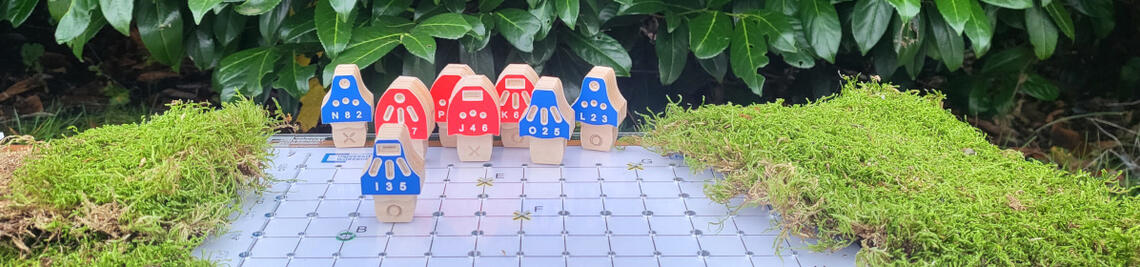
  • The page header shows a decorative image of the experiment kit.
Professorship of Computer Science Education

AI Experiment Kit

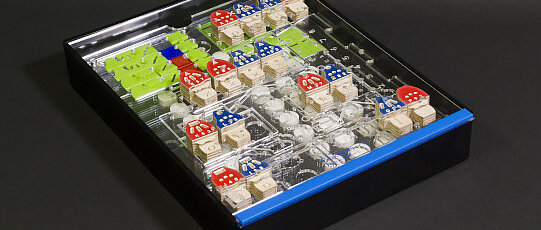
The picture shows the packed AI experiment kit. You can see the mushrooms with their tactile features and the laying plates into which the mushrooms snap into place.

The AI Experiment Kit uses various experiments to teach the difference between knowledge-based and data-based AI systems, as well as how important artificial intelligence algorithms work and their limitations. It was developed by Dr. Silvia Joachim as part of her research work at the Chair of Computer Science Education in cooperation with the Chair of Education for the Visually Impaired and inclusive Education.

Dr. Silvia Joachim – Projects & Publications (German)

Properties of the AI Experiment Kit

  • multifunctional elements for several AI algorithms in one single set
  • unplugged approach, supported by printed and digital materials
  • suitable for different educational levels
  • designed for use in schools, universities, and teacher professional development
  • teaches the core concepts of AI systems
  • provokes critical reflection on opportunities and limitations of AI
  • thoroughly tested and approved by teachers and pupils
  • colorful elements
  • key features are tactile
  • game boards ensure a firm hold
  • suitable for blind and low vision students
  • realised with MEKRUPHY GMBH

Further information (German publication)

Experiment Instructions

The AI Experiment Booklet accompanying the AI Experiment Kit and the teacher's guide are published by MEKRUPHY GMBH and cover the following topics:

  • ‘AI Wins’ – an educational game
  • The decision tree algorithm
  • The k-nearest neighbor algorithm
  • The perceptron and delta learning rule
  • Separating lines
  • Additional experiments: Greedy algorithm, coding

Exclusively in our training courses, experiment instructions on the following topics are also available:

  • AI basics – understanding decision trees
  • Neural networks
  • Unsupervised learning
  • Knowledge-based systems with Prolog

Not all instructions are currently available in English.

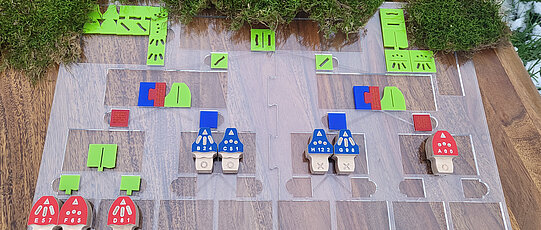
The image shows the game AI-Wins. The game pieces have tactile indentations for the values. The game pieces are placed on a board so that they can be arranged in a meaningful way.

How does machine learning work?

The AI Wins Game provides a playful way to understand reinforcement learning and experience the difference between the knowledge-based approach and machine learning of AI systems.

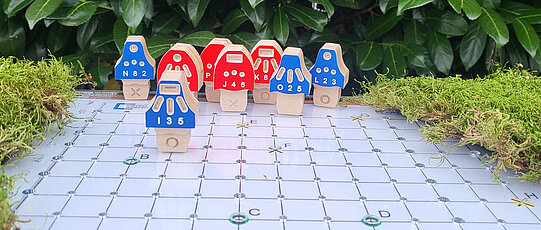
The image shows a coordinate system with tactile coordinates and additional markings. There are some mushrooms on the coordinate system.

How does an AI system learn whether a mushroom is poisonous or edible?

There are several ways to differentiate between the k-nearest neighbor algorithm. The labels engraved on the box lid (continuous attributes) provide a tactile way of understanding the k-nearest neighbor algorithm without a compass or ruler by counting holes.

This coordinate system is also the basis for the perceptron (including the delta learning rule) and a graphical determination of the decision tree.

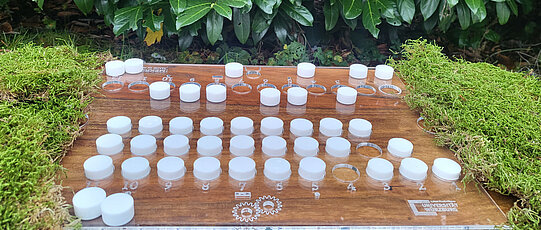
The picture shows the base plate for the decision tree. Some of the mushrooms have already been arranged according to their tactile properties. Small tiles are used to mark the decision options in a tactile way.

How does the decision tree algorithm work?

The decision tree algorithm for binary attributes can be experienced enactively or calculated using entropy as a measure of information content, for example. The use of validation data enables optimisation of the hyperparameter tree height. The data set is chosen so that a lower decision tree can be found without using the algorithm in order to highlight the limitations of a greedy algorithm.

This binary tree plate can also visualise a family tree or an inference engine in a knowledge-based approach, or graph traversals, search algorithms and neural networks.

Evaluation

The deliberately chosen ‘unplugged’ approach has been successfully tested at various levels, from kindergarten to upper secondary school and university teaching, as well as with blind people. It has received extremely positive feedback from teachers and learners in further education courses. In an evaluation after prolonged use in schools, teachers confirm a high level of motivation and good understanding among learners. The experiment kit therefore makes an important contribution to supporting teaching.

In addition to the supplementary materials already available online, the newly developed extensions focusing on neural networks are currently being tested. They also include experiments on data literacy, gradient descent, surface colouring and generative AI. They are expected to become part of the experiment kit shortly.