
SENTRY
Motivation
Since the introduction of CCD detectors aboard the ASCA satellite in the 1990s, X-ray imaging has been a cornerstone of our understanding of high-energy astrophysical phenomena. Today, the emergence of nanosatellites and CubeSats calls for a new generation of X-ray detector technologies that are robust with respect to temperature variations, radiation exposure, and strict power constraints.
These requirements apply across X-ray applications, from planetary remote sensing to X-ray navigation. Within SENTRY, and in collaboration with a german detector company, ESSEO is developing novel, Made in Germany detector technologies for space.
Between 2025 and 2027, the goal is to advance a detector concept to TRL-5 and evaluate its suitability for a first proof-of-concept application, namely X-ray fluorescence detection.
About X-ray fluorescence
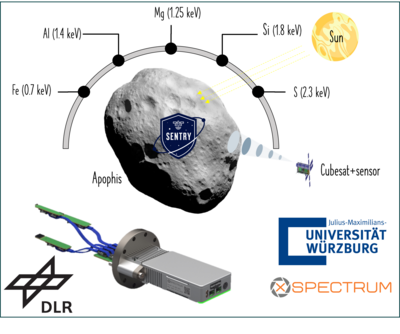
X-ray fluorescence is a natural emission process of planetary surfaces under solar X-ray illumination. It enables direct sampling of the elemental composition of airless bodies such as asteroids, the Moon, and Mercury. Despite its strong scientific relevance, X-ray fluorescence spectroscopy has so far received limited attention in Europe, with most developments historically driven by the UK and non-European missions.
X-ray fluorescence with CubeSats
Detecting X-ray fluorescence from CubeSat platforms is particularly challenging. Strong constraints on mass, volume, power, and pointing stability, combined with the variability of the solar X-ray flux, make fluorescence detection a highly coupled instrument–mission design problem.
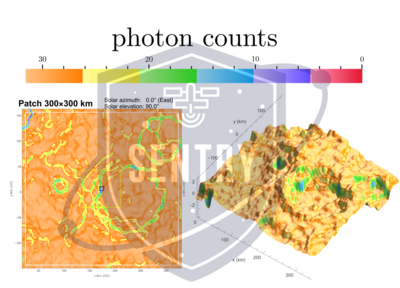
Within SENTRY, we are developing a mission design and performance analysis framework aimed at mapping X-ray fluorescence from the near-Earth asteroid Apophis using CubeSat-class platforms.
Topics for students
We are looking for motivated students interested in contributing to the development of a first CubeSat-scale X-ray fluorescence payload. Possible topics include:
- Mission concept development for asteroid X-ray fluorescence observations
- Radiation environment assessment for X-ray detector
- Detector performance modeling under realistic solar and background conditions
Students will work at the interface between instrumentation, mission analysis, and planetary science.