


Upscaling and Frame Interpolation Techniques for Boosting Light Rendering
07/15/2025This project explores how AI-based super-resolution and frame-generation techniques can significantly enhance the visual quality of light-rendering workflows under strict computational constraints
Background:
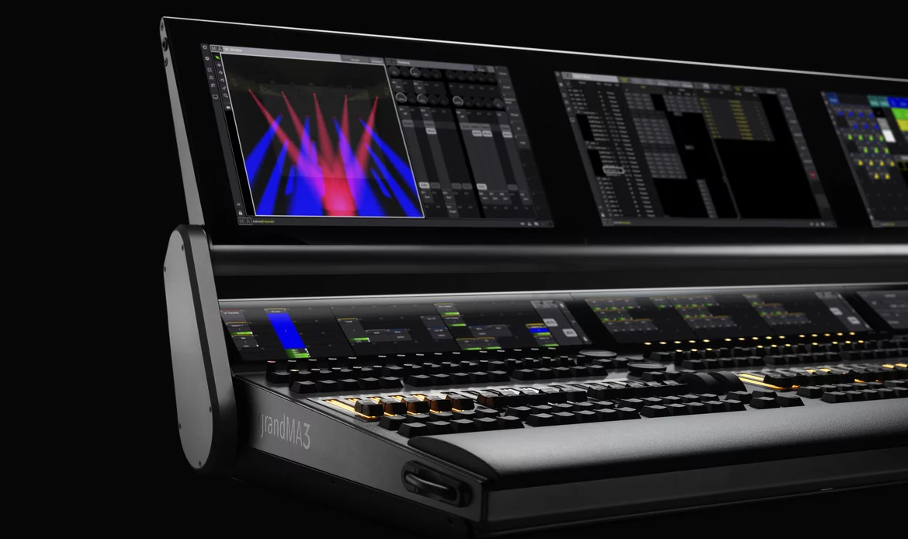
MA Lighting Technology GmbH is a leading manufacturer and creative inventor in the field of lighting entertainment. Their current product range, the grandMA3 series, serves as the motivation of this project.
AI-based rendering enhancements have established in domains like gaming and entertainment, recently. Since the compute power of the grandMA3 prioritises controlling lighting hardware, a low computational load for rendering tasks is essential. Any efficiency gains could, in turn, lead to higher quality visualisation results.
Tasks:
Students need to gather suitable training data from a 3D light visualizer. For this, they need to establish a pipeline (e.g. using Python) to record training and test data sets to be able to start implementing a deep learning framework to focus either on spatial (resolution) or temporal (frame rate) augmentations. In the end, the different techniques could be combined to yield optimal results.
Rigorous efforts toward research, concept design, implementation, evaluation, and documentation are expected.
Independent Projects:
1) Super Resolution Proof of Concept using rendered images of the grandMA3 3D visualizer.
2) Upsampling Proof of Concept using rendered images of the grandMA3 3D visualizer.
3) Frame Generation Proof of Concept using endered images of the grandMA3 3D visualizer.
4) Evaluating combinations of (1) to (3) to gain additional improvements.
The scope of an individual student project will be adjusted depending on the targeted module (e.g. Scientific Internship, Game Research Lab, Bachelor Thesis, or Master Thesis).
Literature
Ghildyal, A., Chen, Y., Zadtootaghaj, S., Barman, N., & Bovik, A. C. (2024). Quality Prediction of AI Generated Images and Videos: Emerging Trends and Opportunities. arXiv preprint arXiv:2410.08534.
Kapse, K. (2021, March). An overview of current deep learned rendering technologies. In 2021 7th International Conference on Advanced Computing and Communication Systems (ICACCS) (Vol. 1, pp. 1404-1409). IEEE.
Yan, X., Xu, J., Huo, Y., & Bao, H. (2024). Neural rendering and its hardware acceleration: A review. arXiv preprint arXiv:2402.00028.
Fu, C. (2024, February). Applications and Limitations of Machine Learning in Computer Graphics. In 2023 International Conference on Data Science, Advanced Algorithm and Intelligent Computing (DAI 2023) (pp. 552-558). Atlantis Press.
Shatokhin, O., Dzedzickis, A., Pečiulienė, M., & Bučinskas, V. (2025). Extended Reality: Types and Applications. Applied Sciences (2076-3417), 15(6).
Supervision
Prof. Dr. Sebastian von Mammen
Dr. Maximilian Landeck, MA-Lighting