Research and Projects
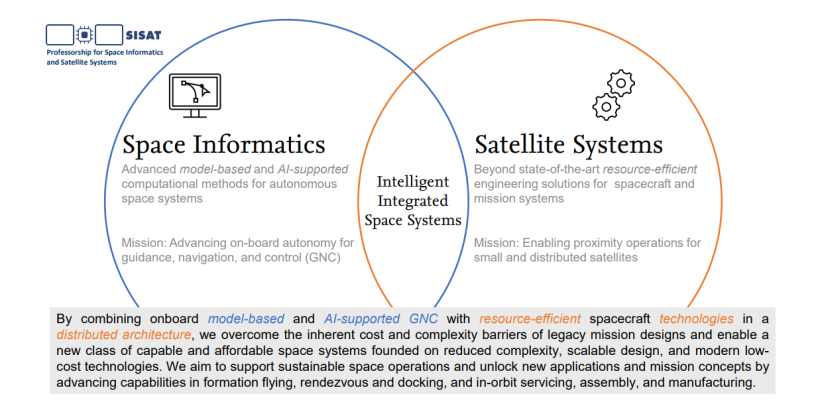
The Chair of Space Informatics and Satellite Systems' (SISAT) research portfolio is built upon two complementary pillars: Space Informatics, understood as the application of advanced, model-based and data-driven methods from computer science to achieve autonomy in space systems, and Satellite Systems, with a focus on the development and analysis of resource-efficient technologies for spacecraft, mission systems, and distributed mission architectures.
This foundation enables research focused on advanced Guidance, Navigation & Control (GNC) for autonomous and distributed space systems, with applications in proximity operations, formation flying, rendezvous and docking, and space sustainability - ensuring safe, long-term use of near-Earth space through debris mitigation and collision avoidance (supporting SSA/SDA)
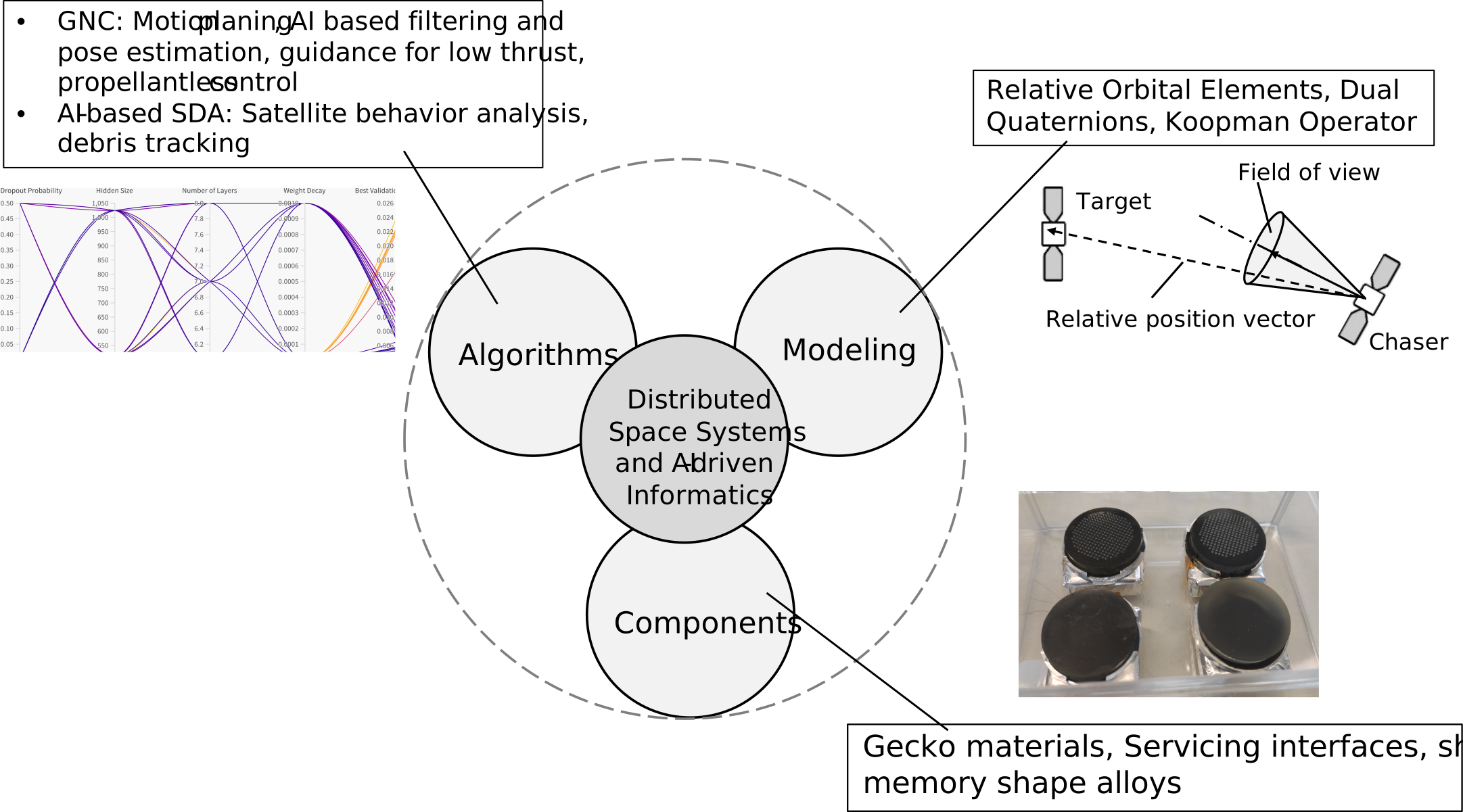
The core methodology combines data-driven techniques (e.g., Reinforcement Learning, Deep Learning) with model-based approaches (e.g., Relative Orbital Elements, Dual Quaternions) tailored specifically to space GNC tasks under realistic constraints - emphasizing practical application over novel AI development.
The SISAT research portfolio (Fig. 2) operationalizes this vision through three interconnected domains: Algorithms (for GNC/SSA), Modeling (analytical and data-driven dynamics), and Components (resource-efficient hardware). Data-driven methods are used to extend and support model-based solutions, all aligned with mission-specific requirements.
Guidance, Navigation and Control
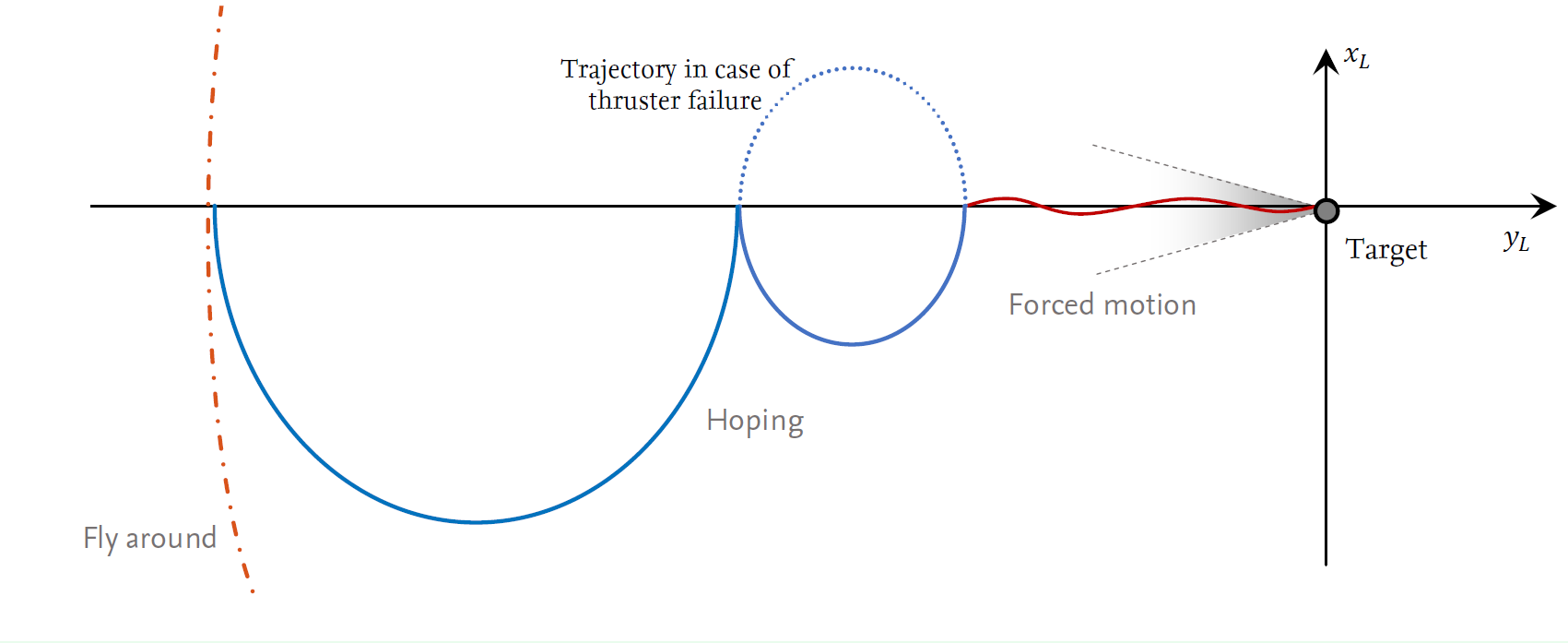
Our team specializes in the development of distributed small satellite systems, comprising coordinated and autonomous spacecraft that operate collaboratively. We design advanced models, components, and algorithms to enhance the Guidance, Navigation, and Control (GNC) capabilities of such formations. A core focus lies in enabling autonomous rendezvous and docking (RVD) operations, precisely locating and physically connecting with target objects in space. Furthermore, we are actively exploring the integration of artificial intelligence (AI) technologies to increase autonomy, resilience, and efficiency in these complex mission scenarios. This includes motion planning, AI-based filtering and pose estimation, as well as guidance for low-thrust and propellantless control.
Vision-based Navigation
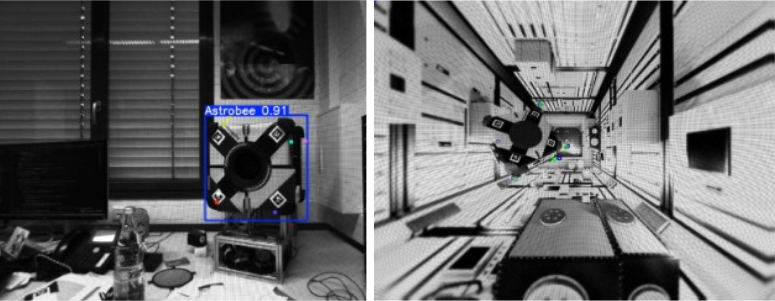
We are advancing vision-based navigation (VBN) systems through machine learning models capable of extracting spatial features from target objects in real time. These models are designed to maintain high accuracy under challenging operational conditions including occlusions, varying lighting, and dynamic viewpoints.
To ensure generalization and robustness in proximity operations, we employ a multi-source training approach that combines synthetic, lab-generated, and real-world imagery. This strategy effectively bridges the domain gap, enabling the AI to learn invariant representations across diverse visual environments. The resulting AI-enhanced navigation frameworks are poised to deliver significant improvements in adaptability, reliability, and performance for close-range autonomous missions.
Adhesive surfaces coated with Gecko materials
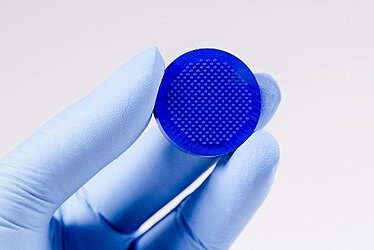
Our concept utilizes satellites with docking surfaces coated with gecko-inspired materials - structured silicone adhesives that enable passive, reversible adhesion upon gentle contact, mimicking the natural grip of a gecko.
These materials offer significant advantages: they are cost-effective, easy to produce, and operate without electrical power. This research is supported by a collaboration between JMU, TU Berlin, and the Leibniz Institute for New Materials in Saarbrücken for material development and application.
The technology will be validated on the International Space Station (ISS) in late 2025 through an autonomous docking simulation under real space conditions. The experiment will employ two NASA Astrobee robots. These are free-floating cubes used for onboard assistance. One will act as a non-cooperative target, while the other, equipped with the gecko-based docking mechanism and tailored algorithms, will perform the autonomous rendezvous and capture (see RAGGA project).