



Modularization and Standardization for Nanosatellite Systems

The Challenge
Nanosatellites, miniaturized spacecraft with masses of only a few kilograms, represent key technology within the emerging New Space sector. They enable cost-efficient missions in telecommunications, Earth observation, and navigation, and are increasingly deployed in coordinated multi-satellite constellations.
Despite their advantages, the widespread use of nanosatellites presents significant technological and engineering challenges. The development and integration of subsystems such as power management, attitude control, communication, and payload modules often rely on diverse electrical interfaces, connector types, and software architectures. This heterogeneity impedes system interoperability and limits scalability for serial production.
To address these challenges, the Bavarian Research Foundation has established the research association FORnanoSatellites – Innovations in Nanosatellites, comprising five academic institutions and fifteen industrial partners. The consortium aims to develop the technological foundations required for sustainable and small-series production of nanosatellites in Bavaria.
Within this framework, the University of Würzburg (JMU) focuses on the modularization and standardization of the nanosatellite bus and its components, with the goal of enabling unified, reconfigurable, and scalable satellite architectures suitable for diverse mission profiles.
Current Research Topics
The research at the University of Würzburg emphasizes the design and implementation of a standardized, modular nanosatellite architecture that facilitates efficient integration and reusability of components across different missions. Current areas of investigation include:
Subsystem Modularization
Systematic identification of dependencies and common interfaces among nanosatellite subsystems to support modular and interchangeable design principles.
Unified Electrical Interfaces
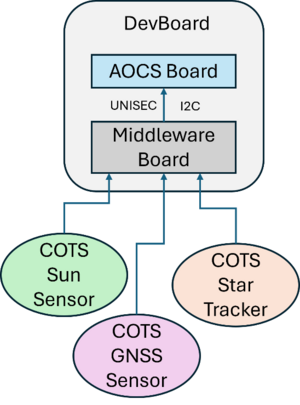
Development of a converter-based hardware layer extending the UNISEC CubeSat Subsystem Interface Definition (CSID) to harmonize communication protocols such as RS-422, RS-485, UART, I²C, and SPI, thereby enabling electrical and data-level interoperability.
Middleware Design
Design of a software middleware layer that abstracts hardware-specific dependencies and supports plug-and-play integration of heterogeneous subsystems, including commercial off-the-shelf (COTS) sensors and actuators.
Automation and Configurability
Establishment of digital design workflows and configuration tools for automated nanosatellite system design, supporting flexible and user-specific mission configurations through a web-based configurator.
Applications and Use Cases
Scalable Satellite Manufacturing
Standardized hardware and software interfaces enable cost-efficient small-series production of nanosatellites, supporting industrial scalability and reproducibility.
Flexible Mission Design
Modular subsystems allow rapid adaptation of satellite architectures to diverse mission requirements in communication, Earth observation, and technology demonstration.
Enhanced Reliability
Hardware and software standardization supports redundancy concepts and ensures robust operation in harsh space environments.
Cross-Platform Compatibility
Unified interfaces facilitate interoperability among components sourced from different manufacturers and research institutions.
Related Websites:
Funded By:
This research project is funded by Bayerische Forschungsstiftung