RAGGA
Relative nAvigation, guidance, and docking using Gecko Adhesives
The space debris population is steadily increasing, threatening space flight operations and requires sustainable solutions. Of the roughly 44,000 trackable objects in Earth orbit only about 13,000 are active satellites. The remainder consists entirely of man-made objects without any function, such as spent satellites. These objects pose an increasing collision risk for operational satellites as well as manned space flight operations. The need for Active Debris Removal (ADR) becomes increasingly crucial to ensure long-term continuation of space flight operations. Capturing space debris howeva, poses unique challenges to the close proximity operations. Debris is non-cooperative, communication systems, attitude determination and control subsystems, etc… are all not working and no dedicated docking interface is available. Uncontrolled these objects typically undergo a tumbling motion, further complicating approach and capture.
RAGGA aims to develop the full Guidance, Navigation, and Control (GNC) pipeline for achieving the close-proximity approach and capture of non-cooperative tumbling objects. Navigation requires a vision-based solution, in RAGGA the use of a monocular camera as the camera sensor is considered. Traditional and AI approaches are investigated for the position and attitude estimation. A Bézier-Curve based motion planner is developed for the Guidance component, with the objective to compute a safe approach trajectory and motion synchronization with the target. Sliding Mode Controller featuring a unique dual quaternion state parameterization are implemented for controlling the chaser spacecraft. Unique to the pipeline is the investigation of applying dual quaternion state parameterization to all GNC components.
The GNC pipeline is undergoing a unique development, verification and validation process. Algorithms are first tested and verified using computer simulations before transitioning to Hardware-in-the-loop (HIL) validation. After component tests, the full GNC pipeline will be tested with HIL on an air-bearing table allowing frictionless movement in 3 degrees of freedom. The chaser free-flyer developed for the air-bearing campaign is shown in Figure 2. The final validation step is planned to be performed on board the ISS utilizing the Astrobee robotic platform. Gecko adhesives are used to achieve the physical capture.
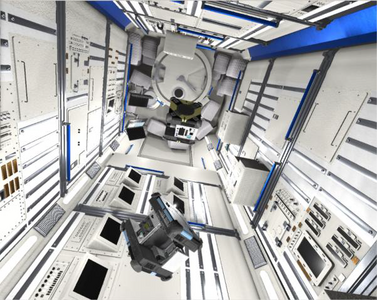
The Figure 1 (above) shows the SISAT ISS Image Synthesizer developed for generating synthetic images of the ISS JEM module interior. The images are utilized in the development of the vision-based navigation.
RAGGA is part of the joint RAGGA-LIZARD project with TU Berlin.
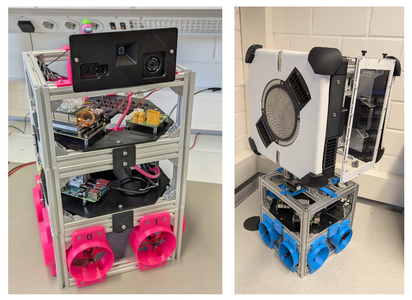
Figure 2: Robotic Free-Flyers for HIL Testing - Princess (left) and Farmboy (right)
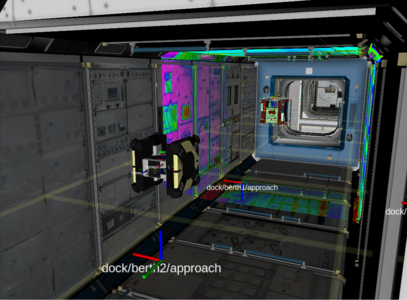
Figure 3: Screenshot of the NASA Astrobee simulator used for software verification and development.
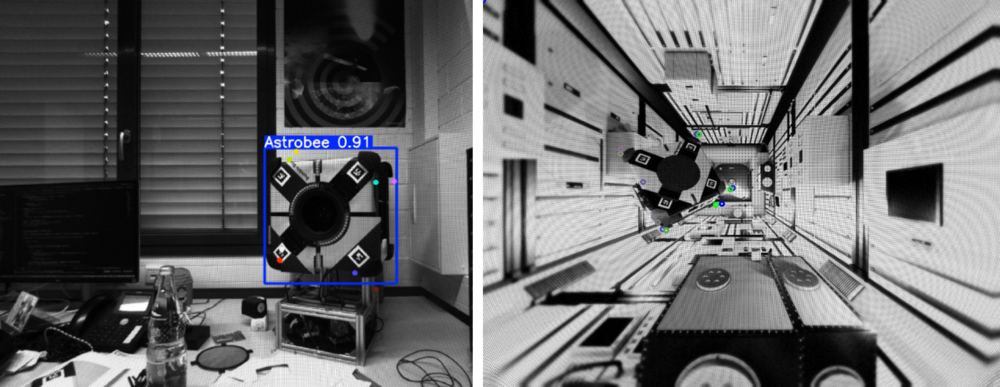
Figure 4 (above) shows keypoint detection by an AI model that has been trained purely with the images from the SISAT ISS Image Synthesizer. The model was able to detect a physical Astrobee mock-up in the real world (shown on the left).
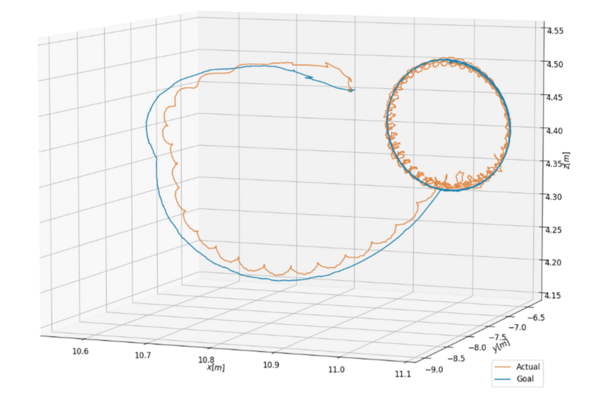
An example of a possible approach trajectory is shown in Figure 5 (right). This was computed using simple rigid-body kinematics and simulated using the NASA Astrobee simulator. Blue shows the goal and orange the actual flown trajectory.