New paper puplished in Energy & Buildings
08.06.2026Our paper “Optimizing heat pump and electric vehicle flexibility through predictive home energy management systems within urban energy digital twins” has now been published in Energy and Buildings.
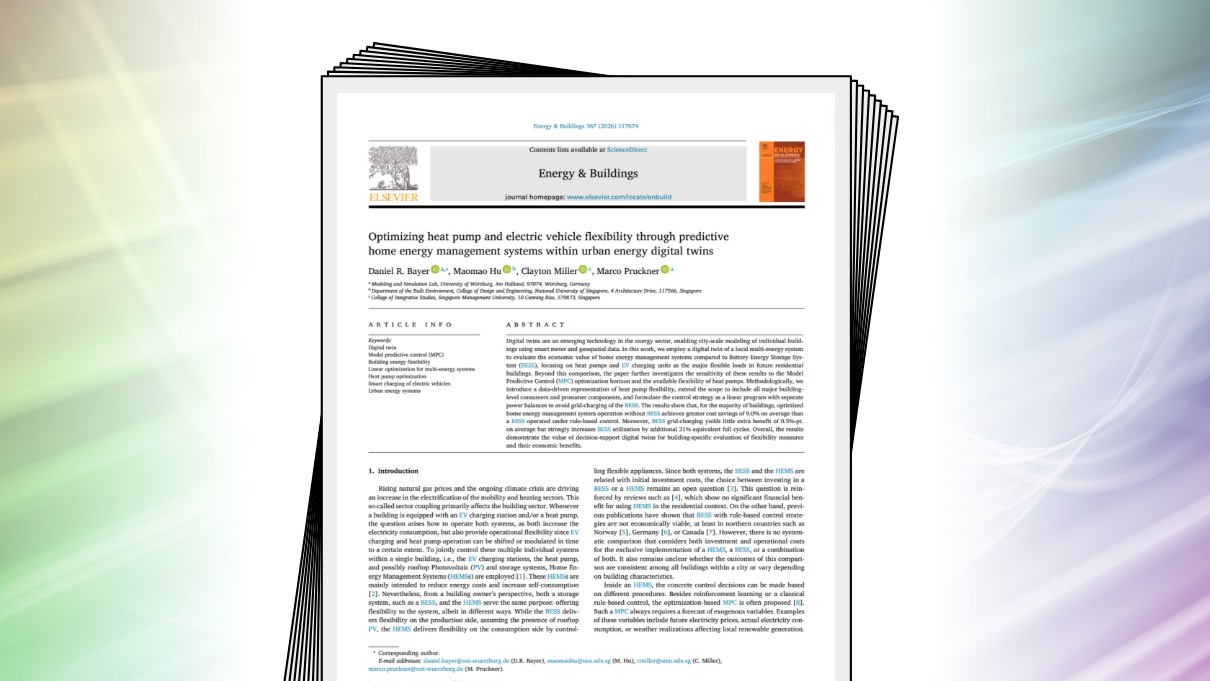
Abstract:
Digital twins are an emerging technology in the energy sector, enabling city-scale modeling of individual buildings using smart meter and geospatial data. In this work, we employ a digital twin of a local multi-energy system to evaluate the economic value of home energy management systems compared to Battery Energy Storage System (BESS), focusing on heat pumps and EV charging units as the major flexible loads in future residential buildings. Beyond this comparison, the paper further investigates the sensitivity of these results to the Model Predictive Control (MPC) optimization horizon and the available flexibility of heat pumps. Methodologically, we introduce a data-driven representation of heat pump flexibility, extend the scope to include all major buildinglevel consumers and prosumer components, and formulate the control strategy as a linear program with separate power balances to avoid grid-charging of the BESS. The results show that, for the majority of buildings, optimized home energy management system operation without BESS achieves greater cost savings of 9.0% on average than a BESS operated under rule-based control. Moreover, BESS grid-charging yields little extra benefit of 0.5%-pt. on average but strongly increases BESS utilization by additional 31% equivalent full cycles. Overall, the results demonstrate the value of decision-support digital twins for building-specific evaluation of flexibility measures and their economic benefits.
Authors: Daniel R. Bayer, Maomao Hu, Clayton Miller and Marco Pruckner
DOI: 10.1016/j.enbuild.2026.117674
URL: https://www.sciencedirect.com/science/article/pii/S0378778826007346