
NOVA
FPGA Based Resilient Earth Observation
Motivation
The rapidly growing volume of data from satellite images poses a challenge for researchers and companies: How can all this data be downloaded and analyzed in a timely manner?
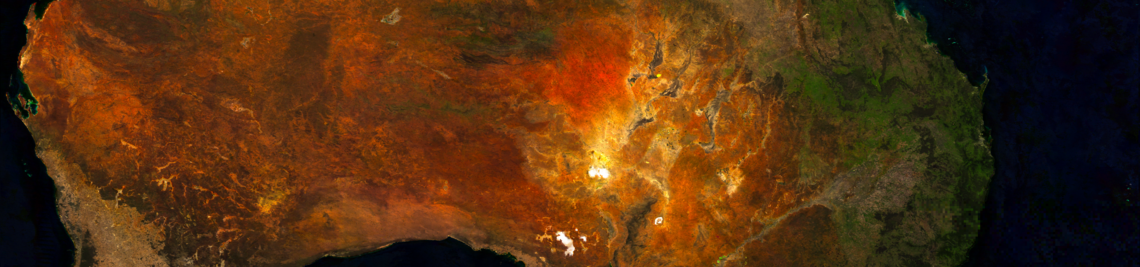
With the number and image quality of earth observation satellites continuously increasing, all this data must be downlinked to ground stations. Further, it must then be analyzed in order to provide actually relevant insights, such as the presence and location of wildfires and vehicles.
With NOVA, we want to help solve this problem by analyzing images onboard the satellite, optimizing the downlink volume and speeding up the delivery of actionable insights.
A New Architecture for In-Space Processing
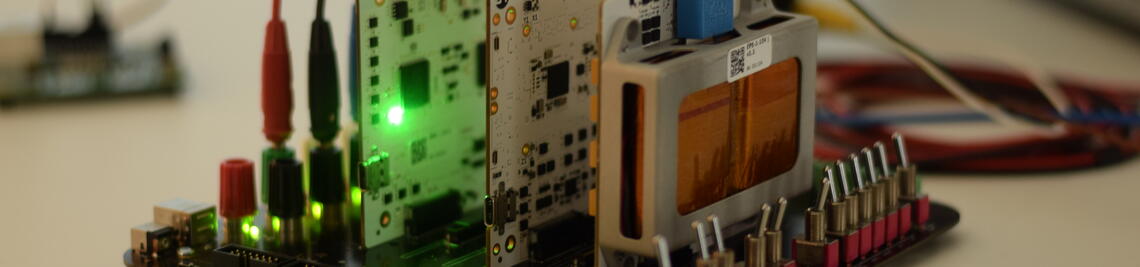
To achieve this, we are developing a novel onboard processing unit built around two Microchip PolarFire FPGA SOCs together with Engineering Minds Munich GmbH. On the hardware side, this payload consists of two PCBs, each containing an FPGA-SoC for interfacing with the satellite bus and the camera payload; on the software side, it consists of a framework for optimizing inference—that is, image analysis using artificial intelligence (AI) or machine learning (ML).
In this process, current telemetry and mission parameters are used to determine which optimization parameter (energy consumption, analysis accuracy, analysis time) is currently the most important. Based on this, an appropriately trained ML model is selected and, if necessary, optimized using the methods mentioned earlier. Subsequently, the most suitable option can be selected from the available architectures and size options for inference accelerators and synthesized in the inference-FPGA on Board 2. The VectorBlox SDK for PolarFire FPGAs is used as a starting point to subsequently investigate the implementation of additional accelerator architectures.

Topics for students
We welcome motivated students interested in Embedded AI and FPGA technology. Possible example topics include:
- Synthesis of AI-Accelerators in PolarFire FPGA-SOCs(clickable to download task description)
- Development of example applications, such as cloud detection, ship detection or land classification
- Integration of onboard-processing payload with satellite bus
Das Vorhaben NOVA - FPGA-basierte resiliente Erdbeobachtung und Aufklärung wird vom Deutschen Zentrum für Luft- und Raumfahrt (DLR) mit Mitteln des Bundesministeriums für Wirtschaft und Energie (BMWE) aufgrund eines Beschlusses des Deutschen Bundestags finanziert (FKZ 50RY2605A).