
NaSA-OMI - Das Netz-als-Sensor: Analyse des Kernnetzes konvergenter Mobilfunksysteme zur Entwicklung neuer Geschäftsmodelle


| Partner | EMnify GmbH |
| Period | November 2025 - December 2028 |
| Researcher | Dr. Stefan Geißler |
| Funding Organization | Bayerisches Verbundforschungsprogramm (BayVFP) des Freistaates Bayern, Förderlinie "Digitalisierung" |
Project Description
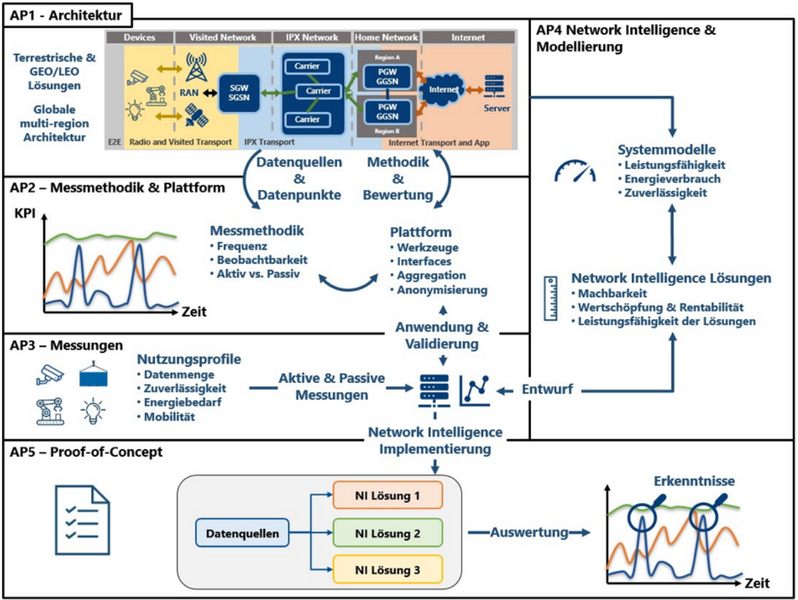
In the NaSA-OMI project, the network is used as a sensor to detect problems in globally operating mobile communication systems, including technical defects, malware infections, and optimization potential for QoS and energy consumption. Based on this, novel Network Intelligence (NI) solutions are being developed for monitoring, analyzing, and optimizing networks. These technologies open up new business models and services for mobile network operators, such as analyzing energy consumption or identifying end-device problems. The goal is to provide innovative value-added services for users of the EMnify platform. These include mechanisms for error detection at the application and network layers, as well as automated system optimizations, such as the intelligent selection of the entry point to the public internet. Integrating new, non-terrestrial connectivity solutions will further expand EMnify GmbH's global service offerings and thus its market position.
The continuous development and proliferation of the Internet of Things (IoT) has significantly changed the requirements for mobile communication systems. IoT devices generate immense amounts of data, the processing of which presents mobile network operators with numerous new challenges. However, the analysis and processing of the acquired data offers new opportunities for mobile network operators. At the same time, technological innovations such as GEO (geostationary) and LEO (low orbital) satellites bring new potential for global connectivity. These developments motivate a more in-depth study of the integration of Network Intelligence (NI) and new connectivity technologies into mobile communication systems in order to meet the challenges of current and future applications.
Project Objectives
Network Intelligence (NI) as a Driver of New Business Models
- Proactive troubleshooting: Automated identification and resolution of network problems before they lead to customer disruptions.
- Improved resource utilization: Dynamic optimization of network utilization based on real-time data and historical patterns.
- Customer-centric services: Individualized service customization based on user behavior and IoT data.
- Cost reduction: Operational and maintenance costs can be reduced through automation and precise fault diagnosis.
Extended Connectivity through Non-Terrestrial Mobile Networks (NTN)
- Performance: Evaluation of latency, bandwidth, and network capacity compared to terrestrial mobile networks.
- Integration into existing networks: Challenges and opportunities of seamless connectivity between terrestrial mobile networks and satellite systems.
- Energy efficiency: Environmental friendliness of satellite technologies and traditional connectivity solutions, for example, by quantifying energy consumption and energy efficiency at the end-user device level.
- Improved network coverage: Seamless integration of GEO and LEO connectivity solutions enhances network coverage for critical applications, especially in remote and hard-to-reach regions.
Combined Consideration of IoT, Network Intelligence, and Satellite-based Cellular Communications
- Global monitoring and control: Network Intelligence (NI) enables the optimization of your infrastructure.
- Expanded business models: Network Intelligence (NI) solutions allow for the detection of network and application-level issues, revealing optimization potential for end customers.
- Improved network stability: Reliable connections through the combination of terrestrial and satellite-based networks.