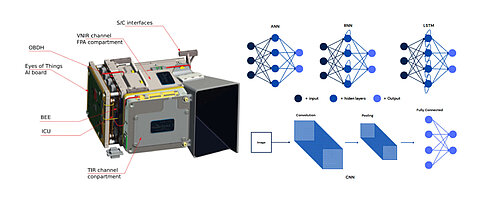
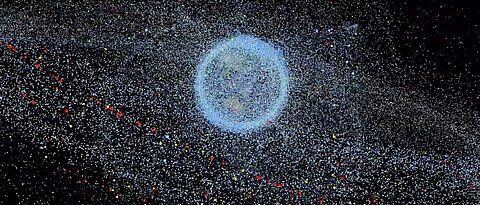
Our paper titled "Artificial intelligence-powered space systems including launch, space, ground and user segments: Current status and future challenges" will be published in Acta Astronautica, Volume 240, March 2026, Pages 328-347.
Mehr
Our paper titled "Artificial intelligence-powered space systems including launch, space, ground and user segments: Current status and future challenges" will be published in Acta Astronautica, Volume 240, March 2026, Pages 328-347.
Mehr
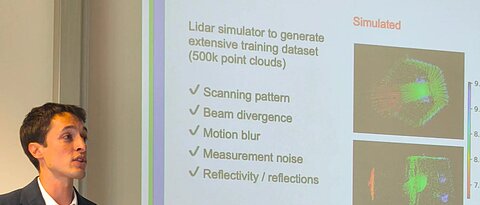
Leo Renaut defended his thesis titled "Lidar Navigation for Non-Cooperative
Space Rendezvous" on 24.09.2025 successfully.
Mehr
Robotics student Marawan Khalil from the University of Würzburg received an award for the best presentation at an international conference. He presented a spherical mapping robot.
Mehr
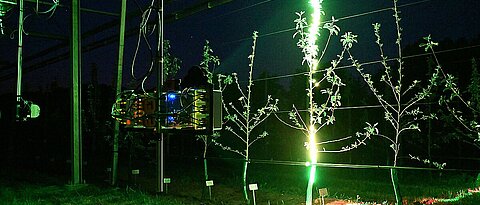
Robotics engineers at the University of Würzburg have developed a novel 3D laser scanner system for precise plant analysis in the field for the Leibniz Institute for Agricultural Engineering and Bioeconomy in Potsdam.
Mehr
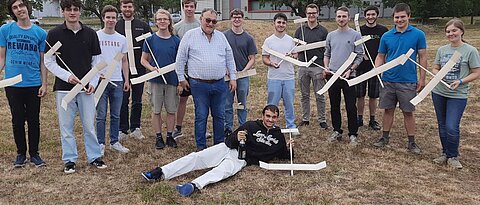
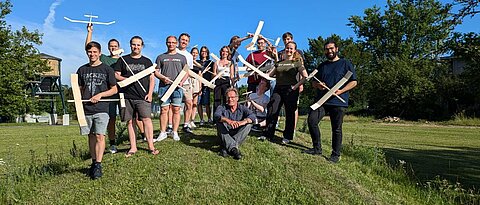
Prof. Walter Baur worked with our space technology students to build and test model aeroplanes in the robotics hall and on our testing area for outdoor robots.
Mehr
Raimund Edlinger defended his thesis titled "Robust Mobility and Manipulation for Flexible and Modular Robot Assistants" on 16.05.2025 successfully.
Mehr
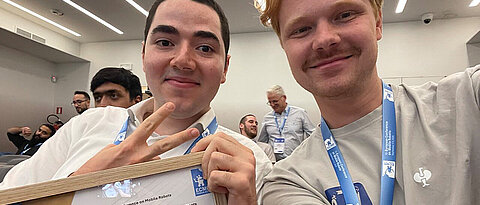
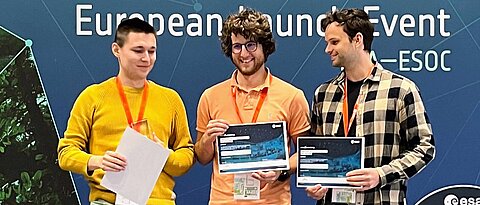
At this year's Computer In A Room Challenge (CIARC 3) hosted by the European Space Agency (ESA), the team from JMU Würzburg – consisting of Satellite Technology students Dennis Reimer, Matei Oana, and Paul Heinisch – secured first place.
Mehr
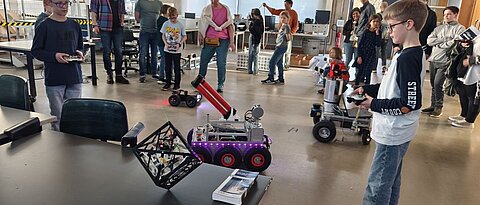
At this year's Space Day in the robotics department, attendees were captivated by an impressive array of technological innovations designed to push the boundaries of space exploration.
Mehr
Researchers at the University of Würzburg have developed a headset that astronauts can use to train for various missions. It has now been tested at the European Astronaut Centre in Cologne.
Mehr
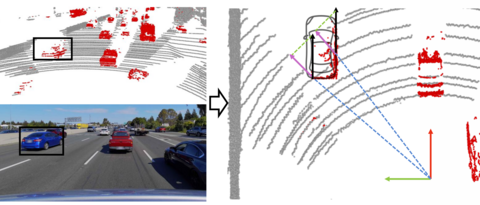
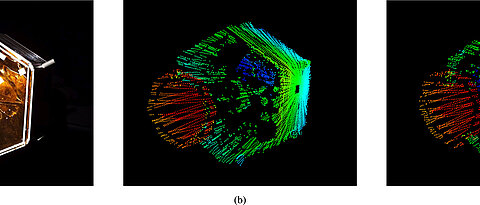
Our paper titled "Deep learning on 3D point clouds for fast pose estimation during satellite rendezvous" will be published in Acta Astronautica, Volume 232, July 2025, Pages 231-243. On test data, the pose estimation is correct in 99.7% of the cases.
Mehr
ENERGIEregion Nürnberg e.V. starts a network for the digitalization of planning, operation and maintenance of solar installations. Chair of Robotics is a partner!
Mehr
Using AI to analyse images from colonoscopies and improve cancer screening: The Wittenstein Foundation is funding this project with a 50,000 euro prize
Mehr
Our student David Baldsiefen wins the ‘AI Innovation in Space’ award at the renowned Massachusetts Institute of Technology.
Mehr
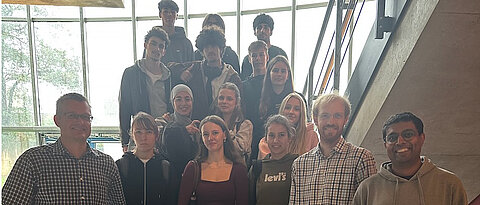
On 26.07.2024 students from the Roentgen-Gymnasium in Wuerzburg visited our Robotics department.
Mehr
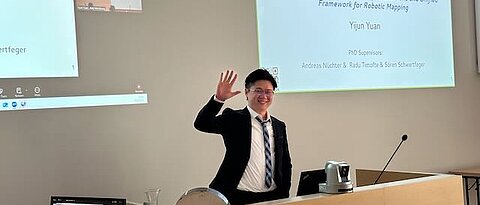
Yijun Yuan defended his thesis titled "Incremental continuous scene modeling - Geometric, Color, Semantic representations and unified framework for robotic mapping" on 18.09.2024 successfully.
Mehr
Prof. Walter Baur worked with our space technology students to build and test model aeroplanes in the robotics hall and on our testing area for outdoor robots.
Mehr
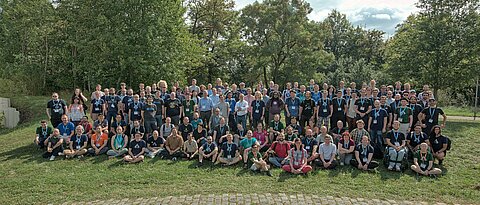
The University of Würzburg (Chair of Robotics), will be hosting "Akademy 2024. Akademy is the annual world summit of KDE, one of the largest Free Software communities in the world. It is a free, non-commercial event organized by the KDE Community. Hundreds of attendees from the global KDE Community, the broad free and open-source software community, local organizations, and software companies will gather in Würzburg, Germany, and virtually from Saturday, September 7th, to Thursday, September 12th, for the annual conference 'Akademy 2024.'
Mehr

AMADEE-24 is a Mars simulation conducted in a desert in Armenia. The expedition serves as an authentic trial run for the astronautic exploration of the Red Planet.
Mehr
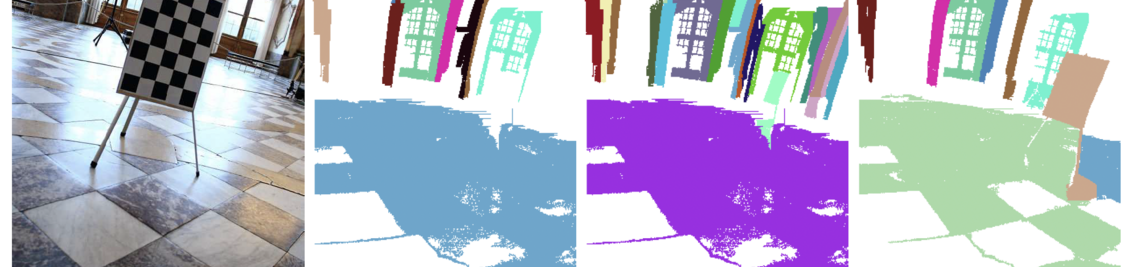
This paper presents Uni-Fusion, a universal continuous mapping framework for surfaces, surface properties (color, infrared, etc.) and more (latent features in contrastive language-image pretraining (CLIP) embedding space, etc.). This is the first universal implicit encoding model that supports encoding of both geometry and different types of properties (RGB, infrared, features, etc.) without requiring any training.
Mehr
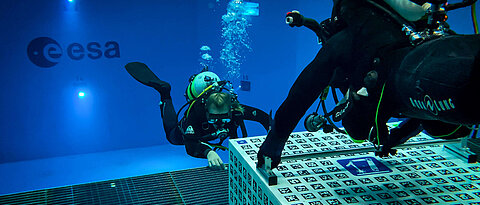
Würzburg computer scientists take a dive -- research study on the use of VR technology in astronaut training concludes. In view of the many possibilities that swimming pools offer for the training of divers or astronauts, a group of researchers led by Prof. Andreas Nüchter has investigated the use of virtual reality (VR) in astronautics.
Mehr